We played 135 rounds in the official demo across two sessions, exported both histories and wrote down every landed floor we could read. This site is what the game actually does — the 50% Cashout threshold, the Re-Buy price, the bonus math — with the numbers next to the claims.
Short version: yes, if you liked the original and wanted a way to leave a round with something. The sequel's three new exits — a 50% Cashout that unlocks at 3.00×, a Re-Buy offer after a collapse at 10.00× or higher, and a 10-floor Bonus Round that cannot bust — change the shape of a session far more than any new graphics would. The stacking itself is unchanged: press BUILD, a floor drops, its multiplier is applied, repeat until you stop or the tower falls.
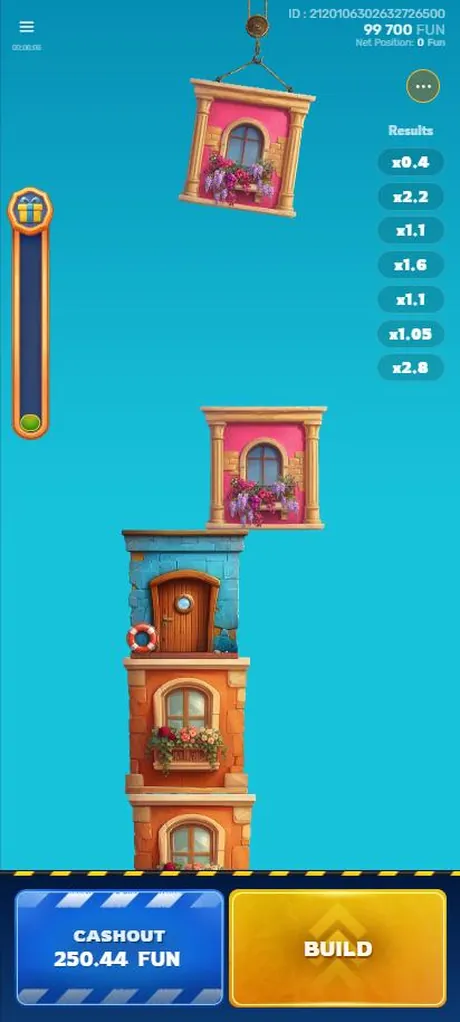
What the marketing does not say and our session did: landed floors are not always above 1×. Thirteen of the 40 floors we logged were between 0.4× and 0.9×, so a "successful" placement can shrink the pot. First-floor collapses were the single most common way to lose (3 of 9 manual collapses). And the Progress Bar moved roughly a third of the way after 36 bets at 100 — a free Bonus Round is a long walk at small stakes.
The game is a browser app designed portrait-first, runs on 4G without a download, and is rolling out across Galaxsys partner casinos, with availability that differs by country — the casino where we confirmed it live is on the where-to-play page. Our full review breaks down the score; the session log has every round; the how-to-play page is the rules in plain words.
Base bet 100 FUN throughout. Session 1: 10 rounds by hand, 25 on Auto-Bet at a 3.00× stop with 2X Chance on. Session 2: 100 Auto-Bet rounds at the same stop, 2X Chance off, in the desktop client. Every round on the session-log page.
Each line is traceable to the in-game rules text; observed values come from our log.
No floor cap; each landed floor multiplies the running total. We logged 2.85× as the best single floor and 0.40× as the worst.
A golden floor that, once placed, drops three more automatically at >1× to 3× each. None in session 1; in session 2 the four Auto-Bet rounds that jumped from under 3× to 9–15× in a single step are consistent with it, so expect one every 25–30 rounds or so.
Ten automatic drops on a night tower. x0 floors subtract the last positive multiplier instead of ending the round.
Fills with every bet; 100% = free Bonus Round. Ours was about a third full after 36 bets.
100× the current bet (10,000 at a 100 stake) for immediate entry.
+25% on every bet — the stake field reads 125 — for twice the bonus trigger odds.
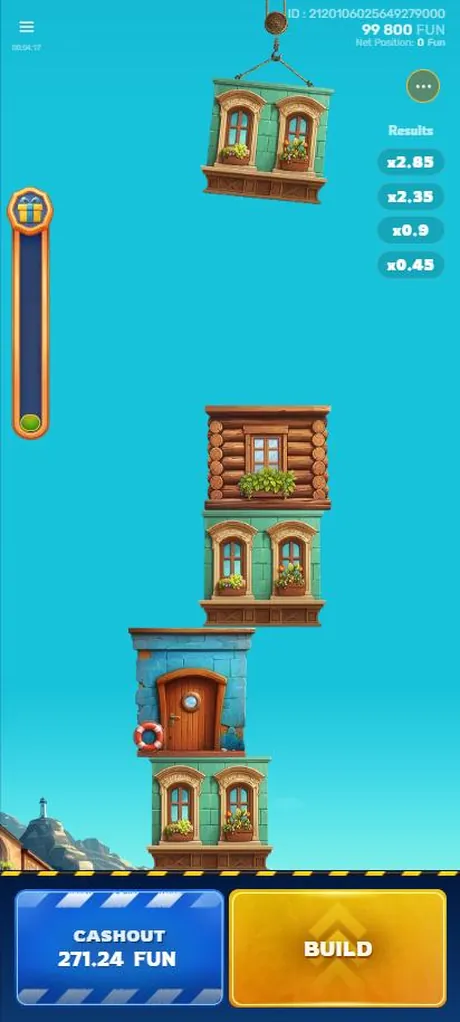
Green tab appears at 3.00×. We used it at 5.01×: 250.44 banked, the other half rode on and collapsed.
After a collapse at 10.00×+, pay 70% of the lost win to continue. None of our towers reached 10× — it is a rare rescue.
Two sessions, 386 landed floors, 23 Auto-Bet cash-outs at 3.00×, one bought and one free Bonus Round. Raw sequences, not averages.


tap to load · Galaxsys demo client · first load 15–25 MB, 10–30 s
Suggested first test, the one we ran: 10 rounds by hand, then 25 on Auto-Bet with "cash out by total coefficient" set to 3.00. Compare your two balances. Instructions on the demo page.
Load the demoTower Rush 2 is a regular Galaxsys release, so it is rolling out across the provider's partner casinos; availability differs by country and keeps changing. The first row is the casino where we ran our real-money test and saw the sequel live on 2026-11-10. Why lobbies differ, and how to find the right tile, on the where-to-play page.
Sent through the contact page after playing. Lightly trimmed; critical notes are published too.
“I came here from a YouTube clip that promised a 'pattern'. This site told me straight that floors are random and showed its own 135 rounds. That honesty is why I bookmarked it.”
“The 3× rule from the session log is what I use now: set auto cashout at 3.00 and walk away from the phone. Boring, but my balance stopped falling off a cliff.”
“Buy Bonus at 100× sounded crazy until I read that the bonus round cannot bust. I tried it twice in the demo: 19× and 64×. Still expensive, but now I know what I am paying for.”
Vikram spent seven years as a QA engineer at two mobile game studios before switching to independent reviewing in 2021. He tests every fast game the same way: a fixed stake, a written protocol, and a round-by-round log pulled from the game's own history panel. He does not accept review fees from operators.